
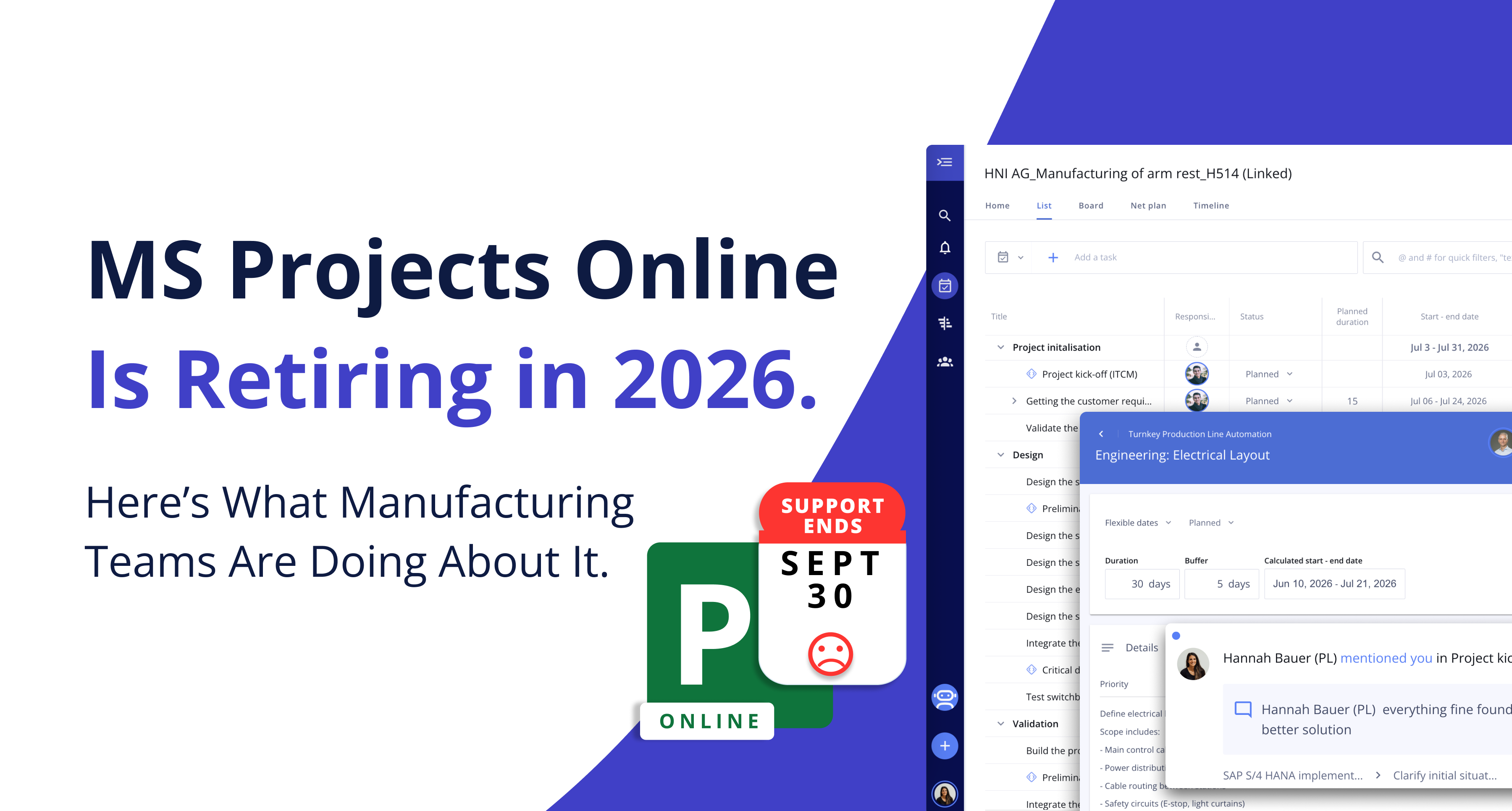
If you manage projects in manufacturing, engineering, or industrial operations, you've likely already heard the news. Microsoft officially announced that Project Online will retire on 30 September 2026. On that date, the platform goes dark and any data you haven't migrated is gone with it.
Surprisingly, many organisations are still in a holding pattern, waiting to see what happens rather than acting. But the migration window that felt distant six months ago is now a sprint.
We'll break down exactly what the retirement means, why Microsoft's suggested alternatives don't work for everyone, and what complex project environments (especially those running 20, 40, 80 projects simultaneously) should actually look at.
What's Actually Happening on 30 September 2026
Microsoft's own announcement on the Project Online retirement is worth reading closely. The legacy architecture of Project Online limits their ability to deliver modern, AI-powered experiences, which is why Microsoft is prioritising innovation within Planner and the Project Manager agent. Feel free to read the announcement here.
In plain terms: the platform was built on older SharePoint infrastructure, and modernising it isn't worth the engineering effort when Microsoft has built something new.
After Project Online is retired in September 2026, you will no longer be able to access your projects or any associated data within the service. That's the part organisations keep glossing over.
There is no grace period, so your migration must be finalised before this cutoff to avoid total data loss. For teams running live portfolios on Project Online today, that means active projects, resource allocations, baselines, custom fields, and years of scheduling history all need to be off the platform before the clock runs out.
The planning window is now. Organisations that begin the process today have a comfortable runway. Those that wait will be competing with every other organisation that also delayed, all while working under time pressure that will inevitably lead to shortcuts and mistakes.
The Microsoft Alternatives
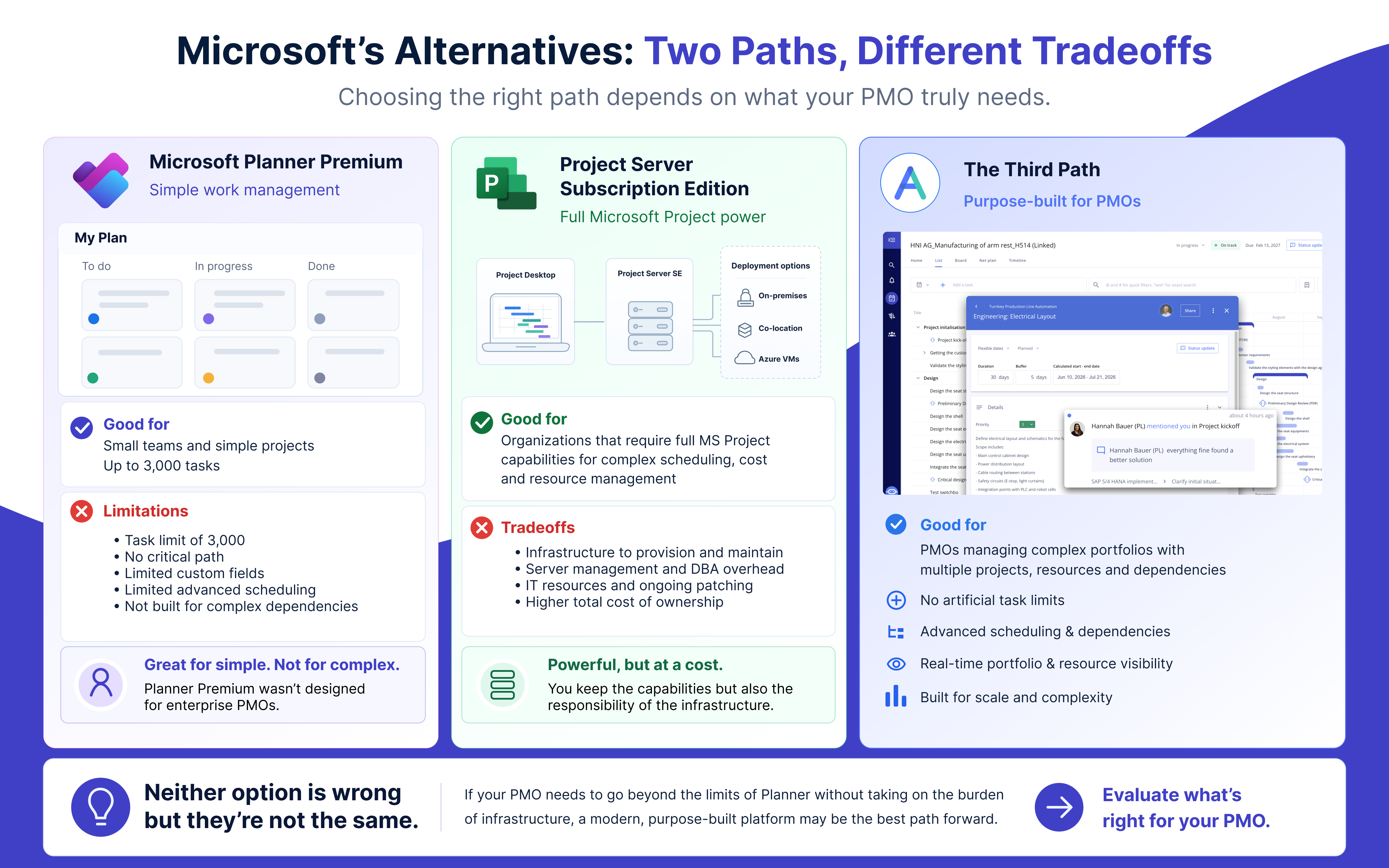
Microsoft points users toward two paths: Planner Premium and Project Server Subscription Edition. Both are legitimate options for some organisations, but neither are straightforward replacements for what Project Online offered enterprise PMOs.
Microsoft Planner Premium
Microsoft limits Planner to 3,000 tasks and has dropped advanced functionality like multiple baselines, critical path constraints, and extensive custom fields. For a team managing ten small marketing campaigns, Planner Premium is probably fine. For a manufacturing PMO running 60 concurrent engineering projects with shared resource pools and inter-project dependencies, those limitations matter a whole lot more.
Microsoft's hoping you move over to Planner premium plans for work management, but many enterprise PMOs find it falls short without significant workarounds. That’s not exactly the turnkey upgrade most teams were hoping for
Project Server Subscription Edition
If you still require the full capabilities of your Microsoft Project Desktop client for schedule, cost and resource management, migrating to Project Server SE is the logical choice. You can operate it on premises, in co-location, or in Azure VMs. This way, your teams retain familiar functionality while moving to a long-term supported platform.
The tradeoff, though, is infrastructure. Instead of eliminating complexity, you're adding server management, DBA overhead, and internal IT burden.
For organisations that want to avoid both the feature ceiling of Planner and the infrastructure cost of Project Server, a purpose-built third-party platform starts looking a lot more attractive.
What Makes a Migration Actually Work
Before evaluating tools, it's worth being honest about why Project Online migrations go wrong. A successful migration requires optimising cloud benefits, integrating existing tools, and (crucially) preparing the people who use them. It’s much more than just moving data from one tool to another.
The technical risks are real, but they’re manageable. The operational risks, though, are where teams get hurt.
The most common failures aren't the data loss or broken imports one would assume. They're include things like: the new platform is so different that PM adoption collapses within 60 days, the custom fields and workflows that took years to configure can't be replicated, or portfolio visibility that leadership depended on disappears entirely, leaving the PMO flying blind for a quarter.
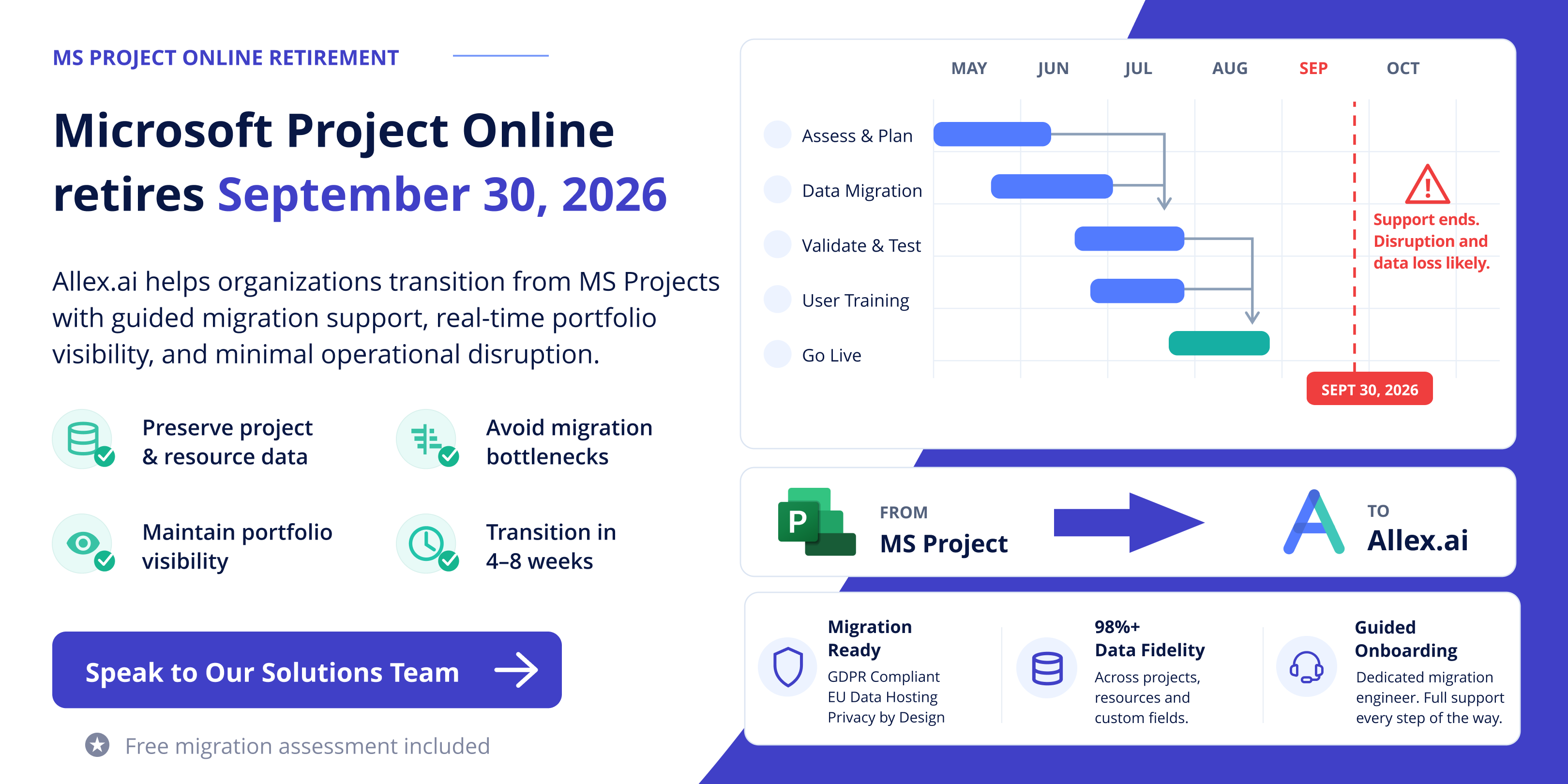
After 30 September 2026, your projects and data in Project Online will no longer be accessible. Therefore, back up your data in good time and migrate to suitable platforms to avoid data loss.
Why Engineering and Manufacturing Teams Are Flocking to Allex.ai
The organisations that will struggle most with the migration aren't necessarily those with the most projects, but those with the most interconnected projects. Manufacturing, robotics, and industrial engineering environments are a specific kind of hard: 40 to 80 simultaneous projects, all with shared resources stretched across programmes, CCPM-based scheduling methodologies, and executive stakeholders who need accurate and updated portfolio visibility without a custom BI layer slapped on top.
That's exactly the complexity Allex.ai was built for.
The Familiar UX Problem (And Why It's Actually Solvable)
One of the loudest objections to any migration is training burden. Project managers who've worked in MS Project for a decade don't want to relearn how to build a Gantt chart. Allex.ai mirrors the structural logic of MS Project (tasks, dependencies, resource assignments, timeline views) so the mental model transfers easier. The difference is that Allex.ai’s underlying engine is more capable, not less.
Existing MPP files import directly, with 98%+ data fidelity on standard project structures. For most teams, the first week in Allex.ai feels more like an upgraded to what they already know, instead of the headache associated with starting everything from scratch.
Portfolio Visibility That Doesn't Require Custom Development
This is arguably the biggest practical upgrade for PMO leaders. In MS Project Online, getting meaningful cross-project portfolio visibility typically required add-ons, Power BI reports, or significant configuration. In Allex.ai, it's included out of the box.
Real-time dashboards show resource demand and capacity across all live projects simultaneously. Bottlenecks surface before they become delivery problems. Budget vs actuals roll up across the full portfolio without anyone exporting spreadsheets.
André Baumann, VP Project Management at Broetje-Automation GmbH, describes managing between 60 and 80 projects simultaneously before the switch: "Thanks to Allex, Broetje can now provide greater transparency and use methods such as CCPM to its advantage. Bottlenecks can be identified early on in the portfolio and countermeasures can be taken in good time."
Resource Management That Closes the Biggest Gap
Cross-project resource management was always Project Online's weakest point at scale. You can get by on manual leveling when you're managing five projects, but what about 50? or 100? It can’t keep up with the complexity inherit in large project portfolios, with resources shared across 15 programmes and priorities shifting weekly.
Allex.ai gives project managers on-demand visibility into current and future resource availability across the entire portfolio, all in one central source of truth. No need to chase down the line managers for updates. Conflict resolutions surface automatically. Capacity scenarios can be run in minutes.
Remo Rickler, CSO at Christof Fischer GmbH, puts a number on what this shift delivered: "We have reduced project lead times by at least 25%, and we are now bringing more machines to market in less time, which is also having a positive impact on our results."
AI-Assisted Planning, Not Just a Marketing Line
The difference between Allex.ai's AI capability and what most tools mean when they say "AI-powered" is worth spelling out. Allex.ai was originally developed on Eliyahu Goldratt's Theory of Constraints and Critical Chain Project Management methodology. The AI layer sits on top of that scheduling logic, meaning it's making recommendations informed by real project constraints, not just surface-level task suggestions.
Practically, this means timelines can auto-adjust when priorities shift, predictive alerts show up on bottlenecks before they materialise, and what-if scenario planning lets you test several variations for future capacity decisions. All built in, not a paid add-on.
The Migration Timeline: What to Expect
Most mid-market migrations to Allex.ai complete in four to eight weeks. Larger enterprise programmes with complex data structures, multiple integrations, and large user populations typically run eight to twelve weeks.
The structured onboarding covers:
- Data audit and field mapping (including custom fields and calendars)
- MPP file import and validation
- Integration setup (Microsoft 365, Azure AD SSO, SharePoint, Teams)
- Role-based training programmes for PMs, resource managers, and executives
- A dedicated customer success representative for the first 90 days
The critical thing to note about the timeline is that Q4 2026 will be brutal for migration services across the industry. Every organisation that’s procrastinated until the last minute will be competing for the same bandwidth at the same time. Organisations typically need 12 to 18 months to properly plan and execute a migration strategy. Starting now means doing this methodically. Starting in August means doing it while the house is on fire.
A Note on Data Privacy for European Organisations
For manufacturing and industrial organisations operating under GDPR, the data hosting question matters as much as the feature set. Allex.ai is developed and hosted in Germany, with all data stored on servers in Frankfurt, within the EU and subject to German data protection law. All data processing is governed by a formal Data Processing Agreement. Role-based access controls, full audit trails, and privacy-by-design architecture are integral to the platform, not added on as compliance features.
For IT and legal teams evaluating migration options, this removes one of the more common blockers in the procurement process.
The Bottom Line
The September 2026 deadline is right around the corner. Access to Project Online data will be discontinued from September 30, 2026. This leaves only limited time for an orderly migration. Such projects require far more than just technical adjustments. Change management, training, and the introduction of new processes are also necessary.
If your organisation runs complex, multi-project environments, especially in manufacturing, engineering, or industrial operations, the migration decision comes down to one question: do you want to figure out a dozen workarounds to address the limitations of a task management tool that was built for something simpler, or manage your projects in a tool specifically designed for their complexity?
Allex.ai's customer base suggests that most industrial PMOs, once they've made the comparison, don't go back. The combination of a familiar UX, genuine portfolio visibility, real-time resource management, and a structured migration programme addresses every concern that typically makes Project Online users reluctant to move.
The deadline isn’t changing. It’s up to you on whether it’ll be a last-minute scramble, or a well thought out upgrade.

Ready to understand your migration timeline and options? Speak to the Allex.ai solutions team for a free 30-minute scoping call. Typically scheduled within two business days. No commitment required.
Download the MS Project Online Survival Guide for a full migration checklist, timeline guidance, and data export instructions.
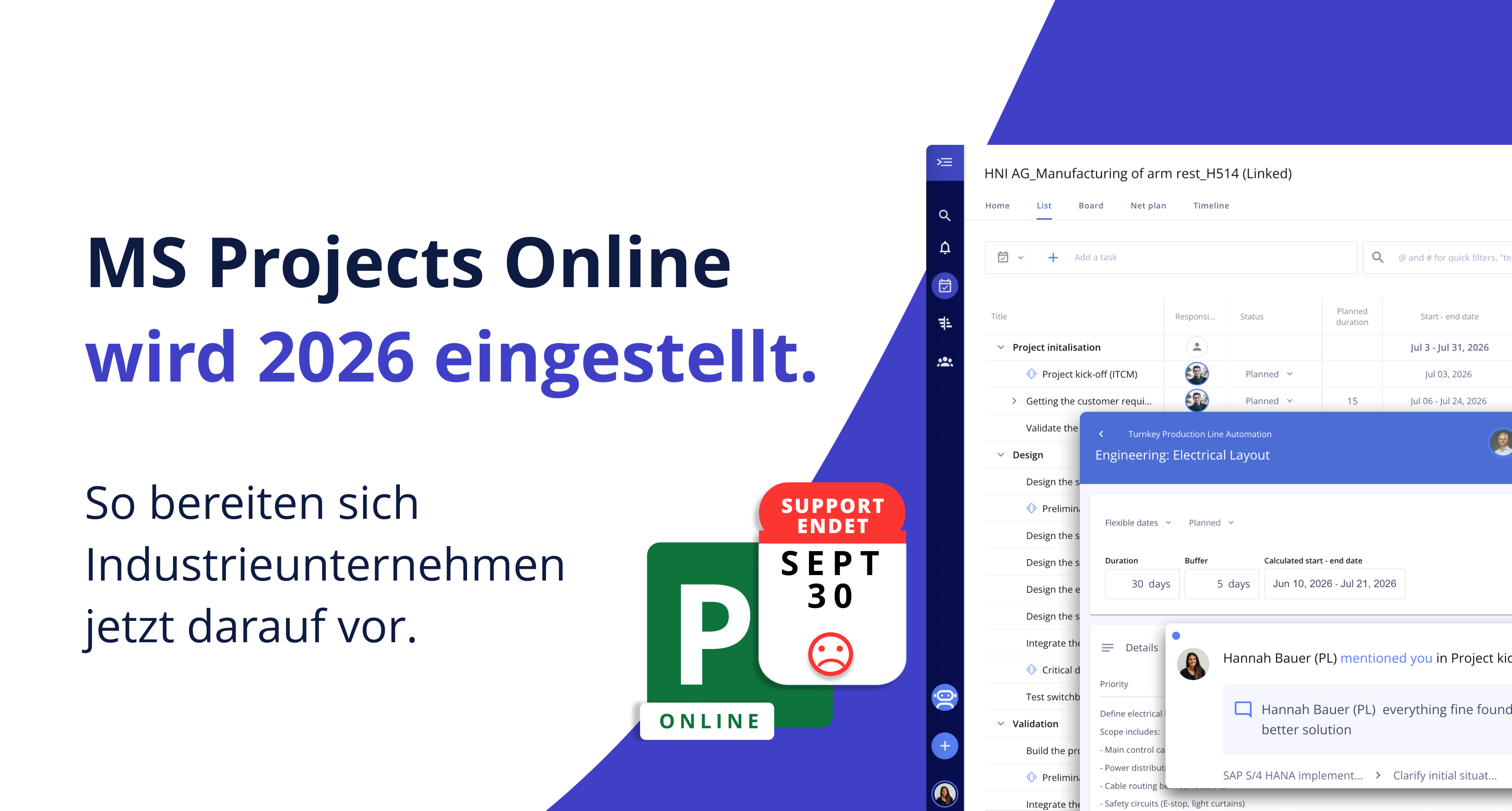
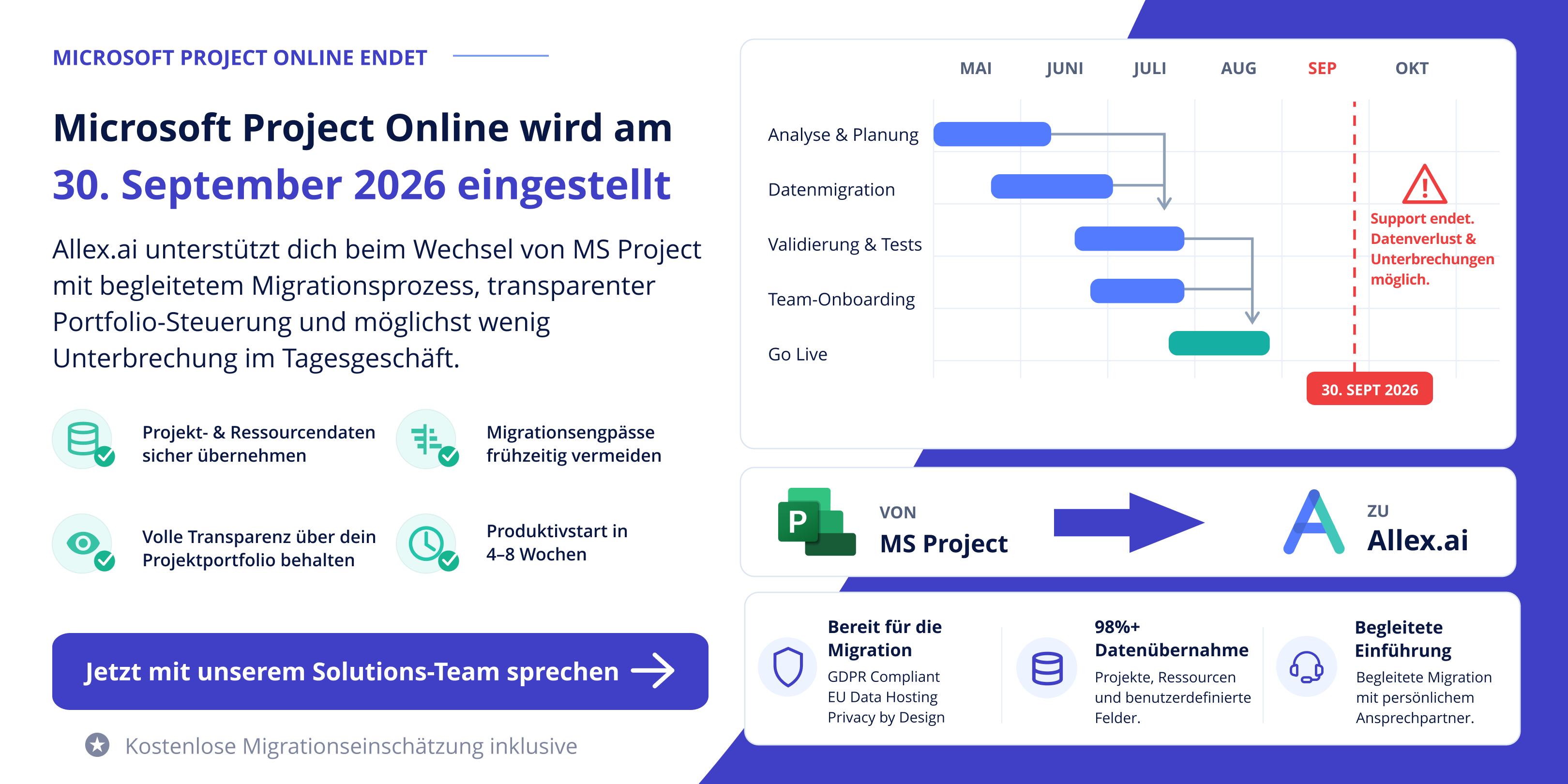
Wer mehrere Projekte in Fertigung, Engineering oder industriellen Unternehmensbereichen steuert, hat die Nachricht vermutlich bereits gesehen: Microsoft stellt Project Online zum 30. September 2026 offiziell ein. Ab diesem Zeitpunkt wird die Plattform abgeschaltet und alle Daten, die bis dahin nicht migriert wurden, sind nicht mehr verfügbar.
Erstaunlich viele Unternehmen befinden sich trotzdem noch in einer Art Warteschleife. Statt aktiv zu handeln, wird beobachtet, diskutiert oder vertagt. Dabei ist aus dem Zeitfenster, das vor sechs Monaten noch weit entfernt wirkte, inzwischen ein echter Wettlauf geworden.
In diesem Beitrag schauen wir uns an, was das Ende von Project Online konkret bedeutet, warum die von Microsoft vorgeschlagenen Alternativen nicht für jedes Unternehmen funktionieren und worauf Organisationen mit komplexen Projektlandschaften tatsächlich achten sollten, insbesondere dann, wenn 20, 40 oder 80 Projekte parallel gesteuert werden.
Was am 30. September 2026 tatsächlich passiert
Microsoft begründet die Einstellung von Project Online mit der bestehenden Architektur der Plattform. Die technische Basis von Project Online schränkt laut Microsoft die Weiterentwicklung moderner Funktionen ein. Künftig konzentriert sich das Unternehmen deshalb auf Planner und den neuen Project Manager Agent. Du kannst dir die Ankündigung hier gerne anschauen.
Vereinfacht gesagt: Project Online basiert auf einer älteren SharePoint-Infrastruktur. Eine grundlegende Modernisierung lohnt sich aus Microsoft-Sicht nicht mehr.
Wichtig ist vor allem eines:
Mit der Abschaltung endet auch der Zugriff auf sämtliche Projekte und zugehörigen Daten innerhalb der Plattform.
Es gibt keine Übergangsfrist. Die Migration muss vor dem Stichtag abgeschlossen sein, um Datenverluste zu vermeiden.
Für Unternehmen, die heute noch aktiv mit Project Online arbeiten, bedeutet das: laufende Projekte, Ressourcenplanungen, Baselines, benutzerdefinierte Felder und teilweise jahrelange Planungshistorien müssen rechtzeitig migriert werden.
Unternehmen, die früh beginnen, können strukturiert planen. Wer zu lange wartet, migriert später unter erheblichem Zeitdruck und konkurriert gleichzeitig mit vielen anderen Unternehmen um dieselben Kapazitäten.
Die Microsoft Alternativen
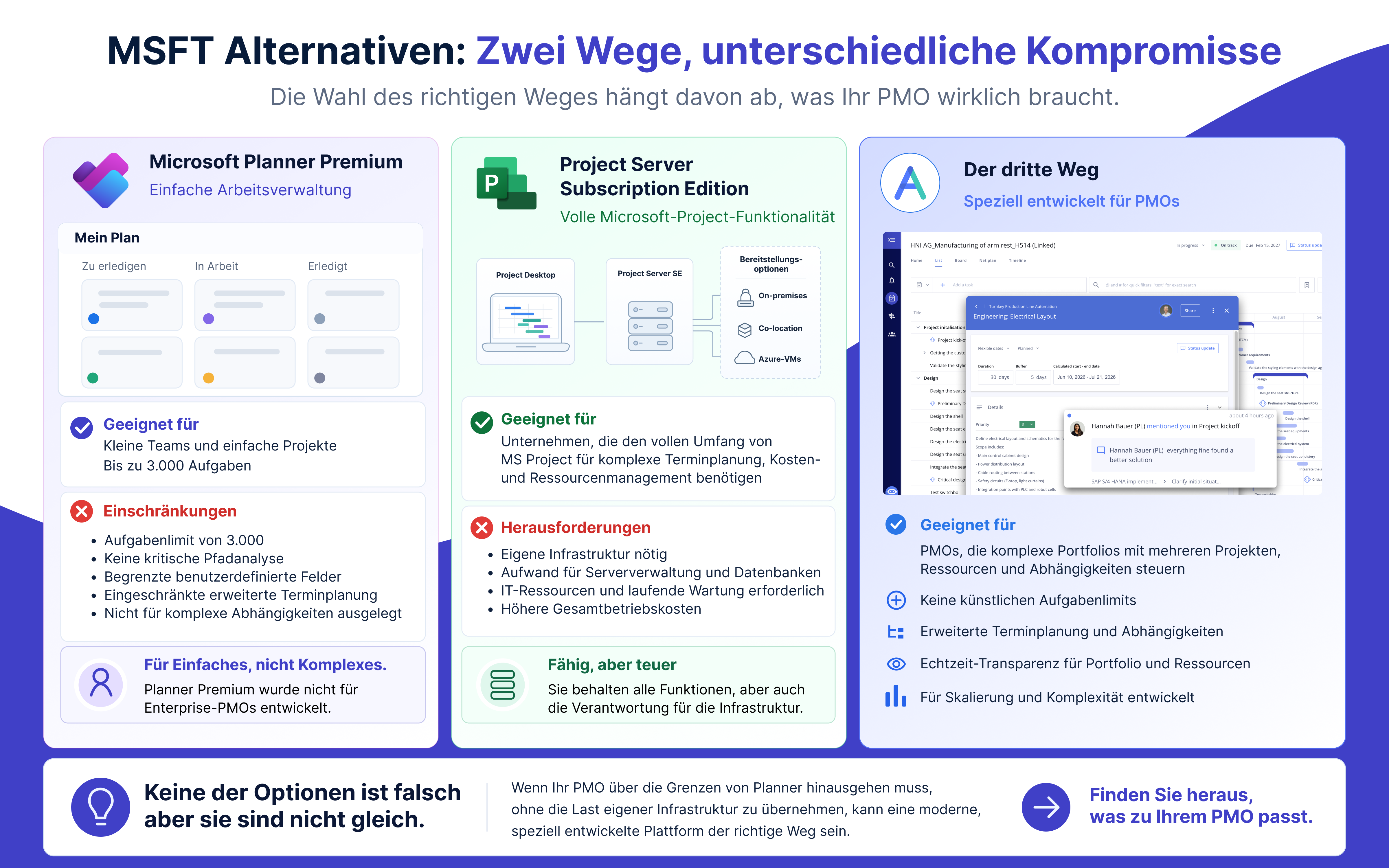
Microsoft verweist aktuell vor allem auf zwei Nachfolgeoptionen: Planner Premium und Project Server Subscription Edition.
Beide Lösungen können für bestimmte Szenarien sinnvoll sein. Für viele Enterprise PMOs ersetzen sie Project Online jedoch nur eingeschränkt.
Microsoft Planner Premium
Planner ist auf 3.000 Aufgaben begrenzt und verzichtet auf Funktionen, die viele PMOs im Alltag benötigen, darunter mehrere Baselines, erweiterte Critical-Path-Abhängigkeiten oder umfangreiche Custom Fields.
Für kleinere Teams mag das ausreichend sein. Für Industrieunternehmen mit vielen parallelen Projekten, gemeinsam genutzten Ressourcen und projektübergreifenden Abhängigkeiten sieht die Realität meist anders aus.
Viele Unternehmen stellen schnell fest, dass Planner ohne zusätzliche Workarounds an Grenzen stößt.
Project Server Subscription Edition
Unternehmen, die weiterhin stark auf klassische Microsoft Project Funktionen setzen, finden in Project Server SE grundsätzlich eine logische Option.
Die Lösung kann On-Premises, in Co-Location-Umgebungen oder in Azure betrieben werden. Dadurch bleiben vertraute Funktionen für Terminplanung, Kostenmanagement und Ressourcensteuerung erhalten.
Die Kehrseite ist allerdings die Infrastruktur. Statt Komplexität zu reduzieren, entstehen zusätzlicher Aufwand für Serverbetrieb, Datenbanken und interne IT-Strukturen.
Für Unternehmen, die weder die funktionalen Grenzen von Planner noch zusätzlichen Infrastrukturaufwand möchten, werden spezialisierte Plattformen zunehmend interessanter.
Woran Migrationen in der Praxis scheitern
Die größten Probleme entstehen selten beim eigentlichen Datenexport.
Kritisch wird es meist danach:
- Projektleiter akzeptieren die neue Plattform nicht
- etablierte Prozesse lassen sich nicht sauber abbilden
- Portfolio-Transparenz geht verloren
- Ressourcen-Konflikte werden schlechter sichtbar
- Teams arbeiten wieder parallel in Excel und Schattenprozessen
Eine erfolgreiche Migration bedeutet deshalb deutlich mehr als nur Daten von einem System ins nächste zu verschieben.
Warum viele Industrieunternehmen zu Allex.ai wechseln
Die größten Herausforderungen haben meist nicht Unternehmen mit den meisten Projekten, sondern jene mit den stärksten Abhängigkeiten zwischen Projekten, Ressourcen und Programmen.
Genau dort entstehen die typischen Probleme industrieller Projektorganisationen:
- 40 bis 80 parallele Projekte
- gemeinsam genutzte Ressourcen
- wechselnde Prioritäten
- projektübergreifende Engpässe
- hoher Abstimmungsaufwand
- fehlende Transparenz über das Gesamtportfolio
Genau für diese Art von Umgebung wurde Allex.ai entwickelt.
Vertraute Arbeitslogik statt kompletter Neustart
Einer der häufigsten Einwände bei Migrationen ist der Schulungsaufwand. Projektleiter, die seit Jahren mit MS Project arbeiten, möchten nicht neu lernen müssen, wie Projekte oder Gantt-Pläne aufgebaut werden.
Allex.ai orientiert sich deshalb bewusst an der strukturellen Logik von MS Project, inklusive Aufgaben, Abhängigkeiten, Ressourcen-Zuordnungen und Timeline-Ansichten. Die Arbeitsweise bleibt vertraut, während die Plattform im Hintergrund deutlich leistungsfähiger arbeitet.
Bestehende MPP-Dateien lassen sich direkt importieren, mit einer Datenübernahme von über 98 % bei klassischen Projektstrukturen. Für viele Teams fühlt sich der Umstieg deshalb eher wie ein modernes Upgrade an und nicht wie ein kompletter Neustart.
Portfolio-Transparenz ohne Sonderlösungen
Gerade für PMOs ist das oft einer der größten Unterschiede.
In Project Online erfordert eine belastbare projektübergreifende Transparenz häufig zusätzliche Power-BI-Reports oder individuelle Konfigurationen.
In Allex.ai gehört diese Sicht standardmäßig zur Plattform.
Ressourcenauslastung, Kapazitäten und Engpässe werden projektübergreifend sichtbar. Probleme werden erkennbar, bevor sie Termine gefährden.
André Baumann, VP Project Management bei Broetje-Automation GmbH, beschreibt den Unterschied so:
„Dank Allex können wir heute deutlich mehr Transparenz schaffen und Methoden wie CCPM gezielt nutzen. Engpässe im Portfolio werden frühzeitig sichtbar und Gegenmaßnahmen können rechtzeitig eingeleitet werden.“
Ressourcenmanagement im großen Maßstab
Gerade das projektübergreifende Ressourcenmanagement war in Project Online für viele größere Umgebungen eine Schwachstelle.
Manuelle Abstimmungen funktionieren vielleicht noch bei fünf Projekten. Bei 50 oder 100 parallelen Projekten mit gemeinsam genutzten Ressourcen wird das kaum noch beherrschbar.
Allex.ai schafft hier eine zentrale Sicht auf aktuelle und zukünftige Ressourcenauslastungen über das gesamte Portfolio hinweg.
Konflikte werden früh sichtbar. Szenarien lassen sich innerhalb weniger Minuten simulieren.
Remo Rickler, CSO bei Christof Fischer GmbH, beschreibt den Effekt so:
„Wir konnten unsere Projektlaufzeiten um mindestens 25 % reduzieren und bringen heute mehr Maschinen in kürzerer Zeit auf den Markt.“
AI-Unterstützung mit realem Projektbezug
Viele Anbieter sprechen inzwischen von „AI-powered Planning“. In der Praxis bleibt allerdings oft unklar, was das konkret bedeutet.
Allex.ai basiert auf den Prinzipien der Theory of Constraints und des Critical Chain Project Managements nach Eliyahu Goldratt.
Die AI-Funktionen arbeiten dadurch mit realen Projektabhängigkeiten und Ressourcenkonflikten statt mit oberflächlichen Task-Vorschlägen.
Konkret bedeutet das:
- Zeitpläne passen sich dynamisch an veränderte Prioritäten an
- potenzielle Engpässe werden früh sichtbar
- Szenario-Simulationen unterstützen Kapazitätsentscheidungen
- Auswirkungen von Änderungen werden projektübergreifend transparent
Wie lange eine Migration typischerweise dauert
Die meisten mittelständischen Migrationen zu Allex.ai dauern zwischen vier und acht Wochen.
Größere Enterprise-Umgebungen bewegen sich typischerweise im Bereich von acht bis zwölf Wochen.
Das Onboarding umfasst unter anderem:
- Datenanalyse und Feldmapping
- Import und Validierung bestehender MPP-Dateien
- Integration von Microsoft 365, Azure AD SSO, SharePoint und Teams
- rollenbasierte Trainings
- dedizierte Ansprechpartner während der Einführungsphase
Wichtig ist vor allem eines:
Die zweite Jahreshälfte 2026 wird im gesamten Markt angespannt sein. Unternehmen, die zu lange warten, werden unter erheblichem Zeitdruck migrieren müssen.
Datenschutz für europäische Unternehmen
Für viele Industrieunternehmen spielt das Thema Datenschutz eine ebenso wichtige Rolle wie der eigentliche Funktionsumfang.
Allex.ai wird in Deutschland entwickelt und betrieben. Die Datenhaltung erfolgt in Frankfurt innerhalb der EU und unterliegt deutschem Datenschutzrecht.
Dazu gehören unter anderem:
- DSGVO-konforme Datenverarbeitung
- rollenbasierte Zugriffskontrollen
- vollständige Audit Trails
- Privacy-by-Design Architektur
Fazit
Der Stichtag im September 2026 rückt näher. Ab dem 30. September 2026 endet der Zugriff auf Daten in Project Online endgültig. Für eine strukturierte Migration bleibt damit nur noch begrenzt Zeit.
Solche Projekte erfordern deutlich mehr als nur technische Anpassungen. Change Management, Schulungen und die Einführung neuer Prozesse spielen genauso eine Rolle wie die eigentliche Datenmigration.
Für Unternehmen mit komplexen Multi-Projekt-Umgebungen, insbesondere in Fertigung, Engineering oder Industrie, läuft die Entscheidung letztlich auf eine Frage hinaus:
Möchten Sie weiterhin mit Workarounds arbeiten, um die Grenzen eines Tools auszugleichen, das ursprünglich für deutlich einfachere Anforderungen entwickelt wurde? Oder möchten Sie Projekte in einer Plattform steuern, die für genau diese Komplexität ausgelegt ist?
Die Erfahrung vieler Industrieunternehmen zeigt: Sobald PMOs die Unterschiede im direkten Vergleich sehen, fällt der Schritt zurück meist schwer.
Die Kombination aus vertrauter Arbeitslogik, echter Portfolio-Transparenz, projektübergreifendem Ressourcenmanagement in Echtzeit und einem strukturierten Migrationsansatz adressiert genau die Punkte, die viele Unternehmen bislang von einem Wechsel abgehalten haben.
Die Frist wird sich nicht verschieben. Die eigentliche Frage ist nur, ob die Migration kontrolliert und strategisch erfolgt oder später unter massivem Zeitdruck.

Sie möchten einschätzen, wie eine Migration in Ihrer Organisation zeitlich und operativ aussehen könnte?
Sprechen Sie mit dem Allex.ai Solutions Team in einem unverbindlichen 30-Minuten-Scoping-Call. Termine sind in der Regel innerhalb von zwei Werktagen verfügbar.
Oder laden Sie den MS Project Online Survival Guide herunter inklusive Migrations-Checkliste, Zeitplan und Empfehlungen zur Datensicherung und Datenmigration.


.svg)
.svg)
.svg)


